AgLEDx Resource Platform for Low-Emission Development

AgLED is intended to be a guide to climate change mitigation in agriculture and food systems for those new and old in the field of low-emissions development (LED). The focus is on agricultural emissions and their mitigation, but we provide examples and resources of emissions and mitigation options related to activities connected with agriculture. One of the biggest opportunities and challenges is in developing countries, where food security has yet to be met while also seeking to reduce emissions. Therefore, this site emphasizes developing country data and examples.

The site has a curated glossary and FAQ, as well as frequently used technical information as basic references throughout the LED Options, Estimating Emissions and Policy & Planning sections. The Estimating Emission and Policy pages have information relating to the UNFCCC and MRV process.

MRV practice: MRV of China’s Sloping Land Conversion Program

In recent years, China has reported greater annual tree cover gains than all the rest of the world combined (Ahrends et al. 2017). The Sloped Farmland Conversion Program (SLCP) has been one of the country’s major policy measures. Piloted in 1999 and expanded nationwide in 2002, the SLCP finances conversion of sloped (>25°) and degraded cropland and wasteland into forest and grassland. Farmers converting these lands receive subsidies in the form of grain or cash. By 2018 SLCP had been implemented on about 30 million ha of land, with 5.3 million ha planned to be converted in the 2016–2020 period. Academic studies have estimated that carbon sequestration due to SLCP can offset about 3%–5% of China’s annual carbon emissions (Deng et al. 2017).

SLCP is one of several LULUCF-sector NAMAs highlighted in China’s INDC and in successive national GHG emission reduction plans, contributing to the national goal of increasing forest area by 40 million ha and stock volumes by 1.3 billion m3 by 2020 compared to 2005. The effects of the SLCP are monitored and reported through several MRV systems, each of which serve different functions.

M&E for programme management

Implementation of SLCP is governed by implementation regulations. Prior to afforestation, contracts are signed between farmers and local governments specifying the planned afforestation area, technical measures and required survival rates. Subsidies are paid after inspection requirements have been met. Local government officials inspect afforestation sites in their areas of jurisdiction and assess compliance against various technical criteria such as tree density and survival rates. The results of field inspection are collated and reported to the province forestry agency, which implements cross-checks before annual reports and any corrective actions are approved. National agencies also cross-check provincial reports by visiting a sample of counties. The resulting data on area and tree stocks provide the basis for national reports on program progress.

M&E of ecological effects

Carbon sequestration is only one of the ecological services targeted by the SLCP. The effects on a range of ecosystem services are measured through a network of 57 monitoring sites and 120 observation sites, with a total of more than 4000 fixed sample plots, where data on hydrology, soil conservation, carbon stocks, air quality and biodiversity are measured. The resulting reports inform policy making at the national level.

MRV of climate benefits

For reporting to UNFCCC, China’s national GHG inventory uses the results of the national forest inventory (NFI) conducted every five years to estimate carbon removals due to biomass stock changes, with interpolation between inventory years. The NFI uses a combination of remote sensing (with coarser resolution at national level, and higher resolution at provincial level) to determine the sampling frame, and sample plots for field measurement of vegetation characteristics (such as diameter at breast height (DBH), tree height and crown cover). Non-forest plots—including some land converted under the SLCP—are included to capture the effects of land-use conversion. Land classification standards for the NFI require that plots affected by the SLCP are noted, but these are then combined with plots afforested due to other reasons to estimate aggregate change in plantation area and forest volumes in planted forest. For the GHG inventory, data from the NFI and other official sources are used to estimate biomass conversion factors and forest stock volume growth rates with which to estimate carbon stock changes in forests, including those afforested through the SLCP.


Expert from Rosenstock et al. 2018, Box 4, pg. 39.

MRV in practice: MRV of subnational agroforestry initiatives in the context of Ghana’s REDD+ strategy

Ghana’s REDD+ Strategy (Ghana 2016) identified the expansion of cocoa and other tree crops as a key driver of forest degradation and deforestation. Ghana’s strategy is to implement large-scale subnational programs in areas defined by ecological boundaries and major commodity drivers of forest degradation and deforestation. An Emission Reductions Programme for the Cocoa Forest Mosaic Landscape (Cocoa Forest REDD+ Programme) and an Emission Reductions Programme for the Shea Landscape of the Northern Savanna Woodland (Shea Savanna Woodland Programme) have been proposed. In addition to addressing commodity-crop drivers, other drivers (such as mining, illegal logging and charcoal production) will be addressed within each program in each ecological zone. The Cocoa Programme is being supported by the World Bank Forest Carbon Partnership Facility (FCPF), while the Shea program has been submitted to the Green Climate Fund, with program steering committees to link the project/program level with the National REDD+ Working Group.

Ghana Cocoa Forest REDD+ Program: Support from the World Bank will materialize in a carbon finance transaction under the FCPF Carbon Fund, whereby the World Bank as the trustee of the FCPF Carbon Fund will pay for emission reductions, duly verified over five years in accordance with the Methodological Framework of the FCPF Carbon Fund and resulting from the GCFPR implementation. Proposed program components include landscape planning, support for climate-smart cocoa production to increase yields, access to finance, and legislative and policy reforms. A reference level for the program area has been defined following the national forest definition, which excludes tree crops such as cocoa but includes timber plantation species. The program reference level forms one input into the national FRL submitted to the UNFCCC. The program MRV system proposes to use high-resolution (Landsat 8) imagery to detect and report forest cover change every two years during the program period, with specific monitoring methods proposed for tracking the key drivers—fire, illegal logging and timber harvest, and fuelwood collection—and for tracking reforestation and tree survival rates. The GCFRP itself is based on a number of private-sector and civil-society-supported initiatives. For example, private-sector-led promotion of climate-smart cocoa production will aim to increase cocoa yields by providing guidelines to inform on-farm production practices and farmer engagement packages to provide access to planting materials, inputs, extension advice, finance and markets. Within the cocoa landscape, increasing shade trees is one climate-smart option. Some projects embedded in the GCFRP have investigated the potential for using carbon-market methodologies to value the carbon increment in the cocoa landscape. Irrespective of whether carbon-market methodologies are found to be sufficiently economically attractive, the private and public cocoa-promotion initiatives will need to have their own monitoring and evaluation systems to track progress.

The proposed Shea Programme includes components to improve landscape governance; shea yields and incomes; and restoration, reforestation and conservation through community-based forest management, including agroforestry. For the forest management component, the project will work with staff from the Ministry of Food and Agriculture and the Forestry Commission to deliver outreach programs to support community forest committees to implement community-based actions. In the GCF concept note, mitigation benefits are proposed to be measured by accounting in relation to the national FREL/FRL, as well as accounting for enhancement of carbon stocks in the savannah ecosystem landscape. The project is still under development, but with carbon stock increments due to agroforestry excluded from the FREL/FRL, the project will clearly need to develop additional M&E systems in order to track progress and account for carbon benefits from agroforestry and community forestry that do not meet the national forest definition.


Sources: Ghana and UNDP (2017), Ghana Shea Landscape REDD+ project. FCPF (2016) Emission Reductions Program Document, Ghana Cocoa Forest REDD+ Programme, published in Rosenstock et al. 2018

Trees Matter: Accounting for silvopastoral systems’ contributions to national GHG inventories

This policy brief covers research by the CGIAR Research Programs on Climate Change, Agriculture and Food Security (CCAFS) and Livestock to strengthen reporting of land-based livestock practices at the regional level. The work aimed to consolidate existing regional climate strategies and policies and create new ones. The brief lays out implications and recommendations for accounting for silvopastoral systems in national GHG inventories.

Versión en español disponible aquí


Suber M , Arango J, Torres C F, Rosenstock T

2020

World Agroforestry

Open- and crowd-sourced MRV for agroforestry?

This brief covers preliminary results from a pilot study using Collect Earth to identify agroforestry on multiple land uses in Viet Nam and Colombia. Collect Earth was shown to be a promising tool that is highly effective in identifying some easily distinguished types of agroforestry systems but falls short with others.


James Daniel, Karis Tenneson, Marta Suber, Rachmat Mulia, Pham Van Thanh, Jacobo Arango,Todd Rosenstock

2018

CCAFS

Enhancing investment in soil health and carbon storage: Frontiers for linking finance and carbon accounting

This website houses resources, recordings, and presentations of the 2020 webinar and hackathon “Enhancing investment in soil health and carbon storage: Frontiers for linking finance and carbon accounting.”

The webinar supported investment-oriented actions promoting soil health and carbon storage by improving the accounting of soil carbon sequestration. Panelists sought to understand how improving soil carbon accounting can support investment-oriented actions that promote soil health and carbon storage. Participants examined opportunities for action using novel methods and frontier technologies that enable linking technical practices with finance and policy for accurate and cost-efficient SOC accounting.

A brief was published as a result of the hackathon that delved into the key insights gleaned from the webinar and two hackathon sessions. Learn more here.


CCAFS, The Nature Conservancy, 4 per 1000 Executive Secretariat, and The World Bank

2020

Inventory practice: Including agroforestry in Nepal’s Forest Reference Level (FRL)

Nepal’s REDD Implementation Center (2017) adopted the following definition of forest for developing its FRL: Land with tree crown cover of more that 10 percent, in an area covering more than 0.5 ha, with minimum height of the trees to be 5 m at maturity and in-situ conditions. The land may consist either of closed forest formations where trees of multiple stories and undergrowth cover a high proportion of the ground, or of open forest formations with a continuous vegetation cover in which tree crown cover exceeds 10 percent. Young natural stands and all plantations established for forestry purposes which have yet to reach a crown density of 10 percent or tree height of 5 m are included under forest, as are areas normally forming part of the forest area which are temporarily unstocked as a result of human intervention or natural causes but which are expected to revert to forest. This includes forest nurseries and seed orchards that constitute an integral part of the forest; forest roads, cleared tracts, firebreaks and other small open areas within the forest; forest in national parks, nature reserves and other protected areas such as those of special environmental, scientific, historical, cultural or spiritual interest; windbreaks and shelterbelts of trees with an area of more than 0.5 ha and a width of more than 20 m. Lands predominantly used for agricultural practices are excluded.

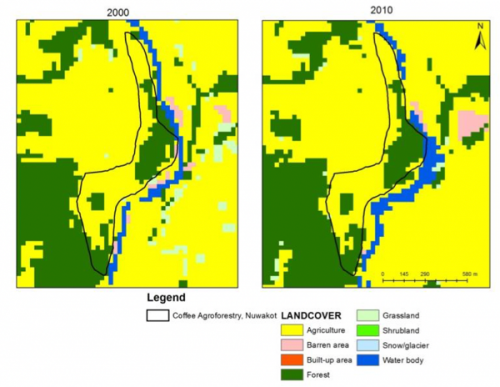
Agroforestry was not explicitly mentioned in the FRL document, but agroforestry patches that fulfill the forest criteria were included in analysis, and forest-cover changes on patches above 2.25 hectares were reported in the FRL. The figure below shows an example of coffee agroforestry in Nuwakot, part of which was included as forest in the FRL dataset.

Coffee agroforestry in Nuwakot, Vietnam, as included in Nepal’s FRL dataset

Source: Case study provided by Bashkar Karky (ICIMOD), published in Rosenstock et al. 2018

Evidence for Resilient Agriculture (ERA)

Evidence for Resilient Agriculture (ERA) platform provides access to data and tools designed to target which agricultural technologies work where. ERA is a dynamic dataset and web portal that is periodically updated with new data. Users can explore the database papers or use the en-suite analysis tool.


World Agroforestry (ICRAF), CGIAR Research Program on Agriculture, Climate Change and Environment (CCAFS), Partnerships for Scaling Climate-Smart Agriculture (P4S-CSA)